
Journal
Articles on document translation
We break down apostilles, legalization, and country-specific requirements — based on real orders.
Articles: 11
A Russian work record book for a Czech trade licence: translating entries, stamps and abbreviations
For "bound" trades in the Czech Republic, work experience can be proven instead of a diploma. We explain how to translate a work record book so that the trade licensing office counts the experience.
A foreigner coming to Russia: which documents to translate for the visa, registration and work
Invitation, migration registration, work permit, bank, notary — where a passport copy is enough and where a notarised translation is needed. Step by step, using the arrival of a specialist from Turkey.
Germany: recognition of a medical degree (Approbation) and why the translation had to be done twice
The state authority rejected a Russian notarised translation of the diploma and transcript. We look at translation requirements for Approbation and how to avoid paying for it twice.
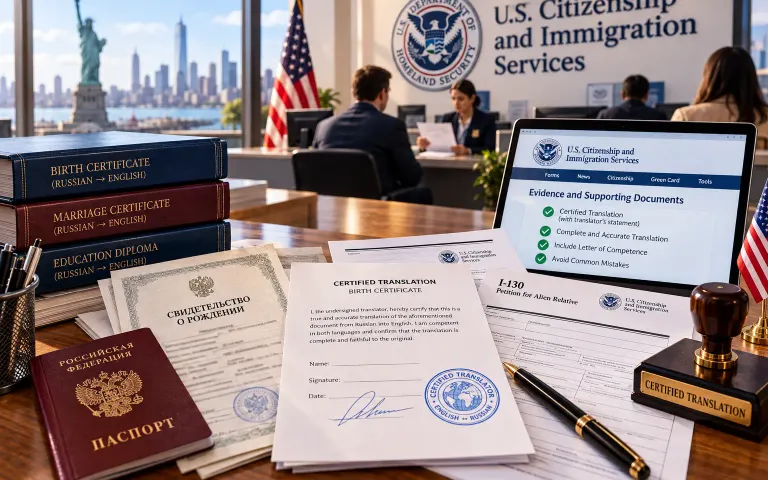
USA: translating documents for USCIS without a notary — why a Russian stamp is not needed there
US immigration expects a "certified translation" — a complete translation with the translator's statement of competence. We explain the format and common mistakes.
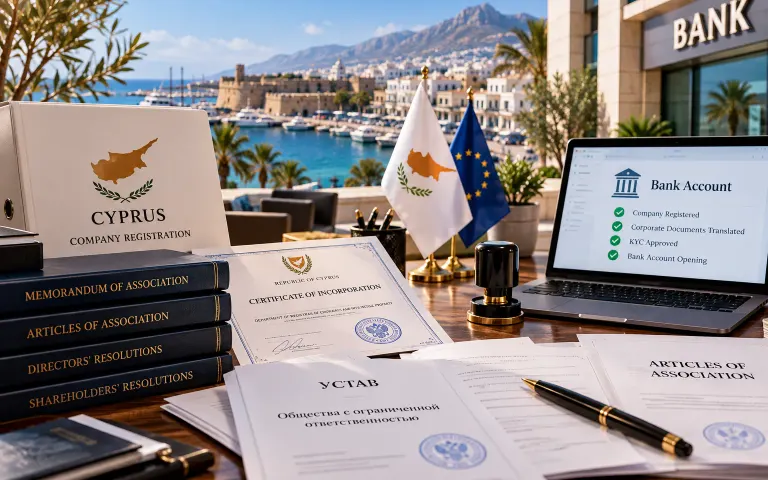
Cyprus: registering a company and translating corporate documents for the bank
The Cypriot registrar and banks check beneficial owners. We explain which founder documents need an apostille and English translation, and why the bank asks for more than the registrar.

Documents for studying abroad: school certificate, transcript and a case of grade conversion
A foreign university received a translation of the school certificate but did not understand the grading system. We explain how to translate it, when an apostille is needed and who converts grades to the local scale.
Translating medical records: a case of a diagnosis that did not match
How inconsistent terminology in the translation of a discharge summary meant a foreign clinic could not reconcile the documents and ordered the work-up again.
Translating the articles of association to open an account abroad: what the bank looks at
A foreign bank's compliance team checks the translation of corporate documents line by line. We go through what most often becomes a blocker and how to avoid it.
Why an agency keeps a glossary: a case of a 200-page contract
On a large document, inconsistent terms turn into a legal risk. We show, with an example, how a glossary, translation memory, and a full editorial pass work.
Translating a diploma for a work visa: a case of an "unrecognised" specialisation
A literal translation of the specialisation name did not match the destination country's classifier — and the employer had to prove the equivalence of the qualification separately.
Page 1 of 2